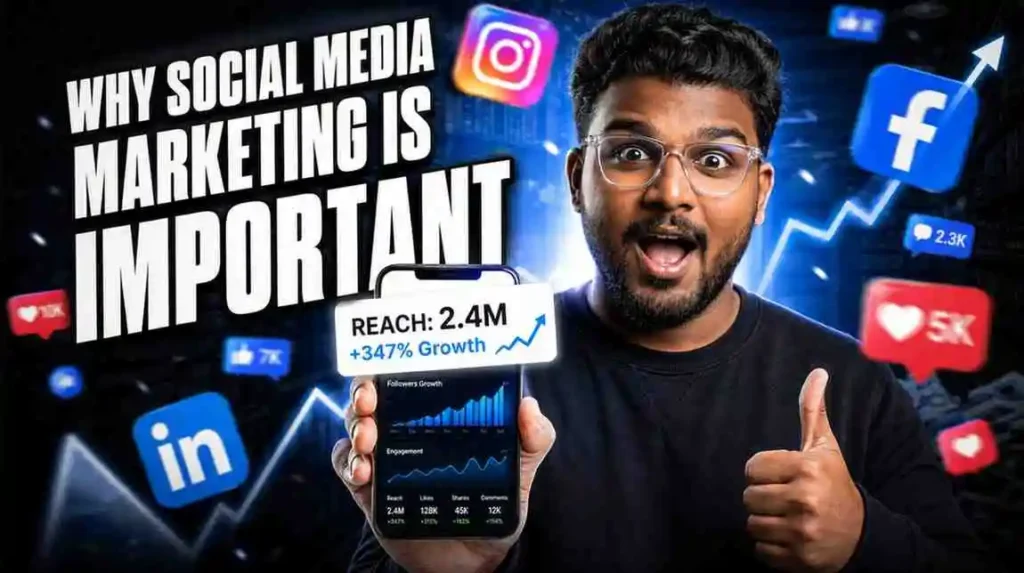
Why Social Media Marketing Is Important for Every Business in 2026
Social media marketing is important because it gives businesses direct access to 5.42 billion active users, builds brand trust through real time engagement, generates leads at a fraction of traditional advertising costs, and signals brand authority to AI engines like ChatGPT, Perplexity, and Gemini that now shape how buyers discover and evaluate businesses before they ever visit your website.
I Said This to a Client Last Week
A manufacturing business owner from Hyderabad called me recently. He said his company had survived 22 years without a single Instagram post and he did not understand why that needed to change. I asked him one question: when did a prospect last find him through word of mouth versus through a search or an AI tool recommendation? He went quiet for a long time.
That silence is where social media marketing lives in 2026. It fills the trust gap between “someone mentioned your name” and “I looked you up, found nothing useful, and called your competitor instead.”
I run an AI-first digital marketing agency from Kukatpally, Hyderabad, registered under UDYAM-TS-02-0308794. My six-member team has run social media strategies for clients across six countries including the UK, UAE, Australia, and the US. We carry a 5.0 Google rating built over three years of actual execution, not slide decks. What follows is what we see working, and what is visibly failing, across those markets right now.
The Numbers That Make the Case
5.42 billion people use social media worldwide in 2026. That is roughly two out of every three people on the planet.
Users spend an average of 139 minutes per day on social platforms. That is more daily time than most people spend eating. If you believe your audience is not on social media, you are wrong about your audience.
58% of consumers say they discovered a new business through social media, a number that currently beats traditional search and television for brand discovery. Social media is a primary discovery channel in 2026, not a secondary one.
Why Social Media Marketing Matters Beyond Brand Awareness
Buyers are evaluating your business on social platforms before they ever contact you. 78% of marketers report that social media increases their brand exposure. Customers who engage with a brand on social platforms spend up to 40% more than those who do not.
73% of social media users say if a brand does not respond on social, they will buy from a competitor. That is not a stat about engagement strategy. That is a statement about how social media has become a basic customer service requirement.
Social commerce is closing the gap between discovery and purchase faster than any other channel. In 2025, purchases through social platforms accounted for 17% of all online sales globally. Instagram had over 70% of its users buying products directly from the app. The distance between “I saw your post” and “I bought your product” is shorter than it has ever been.
The Follower Count Lie Nobody Wants to Say Out Loud
Here is something most social media agencies will not tell you plainly: a large, unengaged follower count is actively harming your brand performance in 2026.
AI engines and Google’s quality signals both measure engagement velocity and sentiment, not raw follower totals. An account with 100,000 followers and a 0.3% engagement rate tells the algorithm something is wrong. An account with 3,000 followers and a 12% engagement rate tells it something is worth surfacing.
I have watched this play out with a real estate client we took over who had 47,000 Instagram followers built through a giveaway campaign. Their posts averaged 90 likes. We rebuilt their content around 800 genuinely interested local buyers and their AI Overview inclusion in local search queries improved measurably within 90 days. The follower number shrank. The business impact grew. Quality wins every time.
You Are Not Just Posting for Humans Anymore
This is the 2026 truth that most marketers are not yet acting on.
When you post on LinkedIn, Reddit, or YouTube, you are not only trying to get a human to click your bio link. You are feeding the data pipelines that large language models consume when building brand entity understanding.
Reddit, LinkedIn, and YouTube ranked among the most-referenced domains by major LLMs in October 2025. When ChatGPT or Perplexity receives a query about vendors in your category, it draws from what it has ingested across these platforms. If your brand has consistent, keyword-anchored content on LinkedIn discussing your expertise alongside community conversations that mention your work, you build what AI engines call brand entity trust.
My team has been testing this deliberately across B2B Healthcare and SaaS clients. We structure LinkedIn campaigns around the same semantic clusters we use in GEO content strategies, with consistent entity-level language across every post. The brands executing this approach appear more frequently when we query AI tools about their service categories. Social media is now a GEO signal. That is not a theory. That is what we are observing in live campaigns.
The 7 Reasons Social Media Marketing Matters Right Now
1. Audience access at a scale no other channel matches.
No channel gives you direct access to 5.42 billion people on organic content alone. A modest but engaged following on the right platform reaches buyers you would pay thousands to target through paid search.
2. Real time customer communication your buyers now expect.
76% of customers expect businesses to offer customer service through social media. A missed DM or ignored comment is a public trust failure in 2026.
3. Social commerce shortens the buying journey dramatically.
When Instagram or TikTok removes the steps between discovery and purchase, your product either converts quickly or loses to a competitor that removes the same friction.
4. Competitor intelligence without paying for a research firm.
Your competitors are publishing their content strategy publicly every single day. What gets engagement, what gets ignored, and what triggers conversations is free market research available to anyone paying attention.
5. Content amplification that feeds your SEO indirectly.
Social shares do not directly affect Google rankings. The inbound links, brand searches, and entity mentions generated when content gets widely shared absolutely do affect your rankings over time.
6. Lead generation that covers both organic and paid channels.
83% of marketers say social media is their primary customer acquisition channel. Brands allocating over 20% of their marketing budget to social report 33% higher ROI than brands investing less.
7. LLM brand entity building that nobody else is doing yet.
This is the 2026 reason no other article in this SERP is writing about. Your social activity trains AI engines to recognize and recommend your brand. Silence on social is silence inside AI search, and AI search is where your next buyer is right now.
The Best Social Media ROI Is One Your Analytics Cannot Track
The highest-value moment social media marketing creates is also the one your tracking software will never capture accurately.
A CFO reads your LinkedIn post about procurement strategy. She does not like or comment. She screenshots it, sends it to three colleagues through WhatsApp, and one of them searches your brand name directly four days later. Your Google Analytics will call that lead “Direct.” Social media did the entire job without leaving a traceable click.
This is Dark Social: private sharing through DMs, WhatsApp groups, Slack channels, and screenshots that drives brand searches with no clickable trail attached.
We see this pattern consistently with B2B clients in the UAE and UK. Their social media analytics look modest. Their direct brand search volume is climbing quarter over quarter. The two are connected in ways attribution software was not designed to measure. If you are judging your social media program purely by cost per lead from a Meta ad, you are measuring one tenth of the actual impact the channel is creating.
Which Platform Works Best for Your Industry
Healthcare and Education
LinkedIn and YouTube build the credibility and educational depth that buyers in these verticals need before they trust a provider. Short-form educational content on YouTube and thought leadership on LinkedIn consistently outperform paid awareness campaigns in these sectors.
Real Estate and E-Commerce
Instagram and Facebook remain strongest for visual product discovery and direct social commerce. Video content on these platforms generates 10 times the engagement of text posts
B2B and SaaS
LinkedIn is the only platform that consistently pays at scale for these audiences. Multi-image posts on LinkedIn pull 6.6% average engagement. Most B2B companies are still treating LinkedIn like a job board. That is a significant competitive gap to step into.
For businesses operating in India: WhatsApp Business, YouTube, and Instagram are the three platforms where local trust is built fastest. We have run healthcare lead generation campaigns in Hyderabad where WhatsApp Business follow-up sequences delivered four times the conversion rate of email campaigns. Platform choices always follow your audience, never a generic framework.
How to Actually Measure Whether It Is Working
Stop watching follower counts. Start tracking these three numbers instead.
Engagement rate per post by platform.
Benchmarks in 2026 sit above 1% on Instagram, above 2% on LinkedIn, and above 4% on TikTok for accounts performing competitively.
Brand search volume in Google Search Console over a rolling 90-day window.
If social activity is doing its job, direct and branded searches climb. That movement is your real attribution signal, even when last-click models miss it entirely.
AI Overview inclusion for brand-relevant queries.
Search “best [your service] in [your city]” and note whether your brand appears in the AI generated answer. That appearance is a direct product of your combined social and content authority signals.
Frequently Asked Questions: Why Social Media Marketing Is Important
Why is social media marketing important for small businesses?
Social media marketing gives small businesses access to the same audience reach as large brands at a fraction of the cost. Organic posting, community engagement, and social commerce tools require no minimum ad spend. For local businesses, platforms like Instagram and WhatsApp Business consistently outperform expensive traditional advertising channels on measurable lead quality and conversion rates.
How does social media marketing help with SEO in 2026?
Social media does not directly affect Google rankings, but it amplifies the signals that do. Brand searches, inbound links, and entity mentions generated through social sharing feed into Google’s authority assessment over time. Active social profiles also increase the volume of content Google can index and associate with your brand entity across the full web.
What is a good engagement rate on social media in 2026?
A healthy engagement rate varies by platform. LinkedIn averages 6.5% for high-performing content. TikTok performs best at 4 to 7% for accounts under 100,000 followers. Instagram sits around 1 to 3% for business accounts. Engagement rate matters significantly more than follower count because it signals content quality to platform algorithms and AI crawlers evaluating your authority.
How does social media marketing affect AI search visibility?
Platforms like Reddit, LinkedIn, and YouTube are primary data sources for large language models including ChatGPT, Perplexity, and Gemini. Consistent, keyword-relevant posting builds brand entity recognition inside these AI systems. Brands with active, structured social presence are measurably more likely to be cited or recommended when AI tools answer purchase-intent questions in their category.
Is social media marketing worth the investment for B2B companies?
Yes, specifically on LinkedIn. LinkedIn delivers a 6.6% average engagement rate for multi-image posts and is the top ROI channel for B2B brands per HubSpot’s 2026 marketing report. B2B buyers increasingly research vendors through LinkedIn content before any direct outreach occurs. A dormant LinkedIn profile signals low authority to both human buyers and AI systems evaluating vendor options.
Which social media platform gives the best ROI in 2026?
Facebook and Instagram consistently deliver the highest overall ROI according to global marketers as of 2025. LinkedIn leads for B2B and professional services. TikTok outperforms on organic engagement and brand discovery for consumer-facing brands. The best platform is always determined by where your specific audience spends time. ROI follows audience fit, content consistency, and posting quality, not platform reputation alone.
How much does social media marketing cost for a small business in India?
Organic social media marketing costs nothing beyond content creation time. Paid social campaigns on Meta platforms can start at INR 500 per day in India. Professional social media management services range from INR 10,000 to INR 50,000 per month depending on platform count, content volume, and whether paid advertising management is included in the engagement scope.
What is Dark Social and why does it matter for measuring ROI?
Dark Social is the private sharing of content through DMs, WhatsApp, Slack, and screenshots that drives brand searches without leaving a trackable clickable link. Analytics platforms attribute these resulting visits to “Direct” or “Organic Search.” Brands that ignore Dark Social consistently underestimate their social media ROI. Tracking direct brand search volume over time is the most reliable proxy measurement currently available.
How many social media platforms should a business focus on?
Start with two platforms where your target audience is most active. Spreading output across six platforms with low-quality content produces weaker results than consistent, high-quality posting on two well-chosen channels. Quality and posting consistency per platform outweigh platform count every time. For most Indian businesses, Instagram combined with LinkedIn or YouTube covers the widest B2C and B2B reach simultaneously.
Does social media marketing work for healthcare businesses?
Yes, with awareness of medical advertising compliance requirements in your region. Healthcare businesses use LinkedIn for professional authority and YouTube for patient-trusted educational content. Doctor-led educational formats and community Q&A posts consistently outperform promotional messaging in this sector. Social proof in healthcare directly influences booking rates and referral volumes from existing patients more than any paid campaign format.

Need Help Growing Your Business Online?