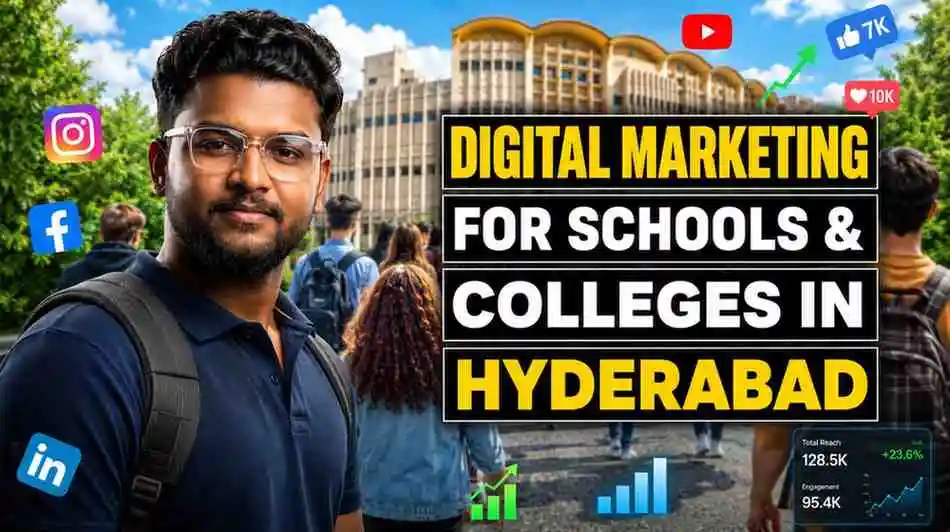
Digital Marketing for Schools and Colleges in Hyderabad: What Actually Fills Seats in 2026
By Nithish Reddy | nithishreddy.in | Kukatpally, Hyderabad
Digital marketing for schools and colleges in Hyderabad works when it targets admission intent directly through SEO, AEO, and AI search optimization — not when it chases impressions. The institutions that filled seats fastest in 2026 built organic authority before EAMCET counselling season opened, automated their inquiry follow-up within 45 seconds, and showed up in ChatGPT and Perplexity answers before they spent a single rupee on ads.
That is the short version. Here is everything behind it.
The Admission Lead Problem Nobody in Hyderabad Is Talking About
I have audited more than 20 educational institutions across Kukatpally, Gachibowli, and Secunderabad over the past two years. The pattern is almost identical every time.
The college has a website. The website loads slowly. It has one generic “Contact Us” page and no structured content that answers what parents or students are actually searching for.
The result is predictable: 74% of high-intent leads generated during the TG EAPCET counselling window drop off because the tele-calling team takes longer than four hours to respond. The lead was hot. The timing was wrong. The seat went to a competitor who had a WhatsApp automation live.
Your Hoardings Are Funding Someone Else's Admissions
I am going to say something that will annoy a few people in this industry. The Rs. 4 to Rs. 6 lakh you spent on flex boards across KPHB, Madhapur, and the Secunderabad flyover this April? That spend created broad market awareness. The actual decision happened later, when a parent sat down at 11 PM and typed a query into Google AI Overviews or asked Perplexity: “Which B.Tech college in Hyderabad has the best CSE placements under Rs. 1 lakh fees?”
If your institution does not appear in that AI-generated answer, the awareness your hoarding created goes directly to whichever college does appear. You warmed up the audience. Your competitor closed them.
This is not a small problem. UPCEA Search Influence AI Search in Higher Education 2025 found that half of all prospective students now use AI tools weekly during their college search, and 69% of Google queries end without a single click. The decision happens inside the AI answer. Institutions that are not cited there are invisible at the moment of decision.
Fire the Designers: High-Converting Admission Funnels Run on Text and Speed
I do not offer graphic design or video production at my agency. I made that call deliberately. And I am more confident in it now than I was when I started.
Here is the technical reason. The April 2026 Google Core Update rewards pages that load fast, structure information cleanly, and allow AI crawlers like GPTBot, PerplexityBot, and Google-Extended to extract content without fighting through JavaScript-heavy themes or auto-playing videos. A beautifully designed school website with parallax scrolling and a 4.8-second mobile load time fails Core Web Vitals and gets outranked by a faster, plainer competitor that structures its admissions FAQ in clean HTML with proper schema markup.
The highest-converting admission landing pages I have built for institutions in Hyderabad use three elements: a direct headline targeting one specific course, a 60-word answer block that tells the visitor exactly what they need to know, and a WhatsApp CTA that routes to an automated ManyChat flow within 45 seconds. No intro animation. No slider. No stock photography of students throwing mortarboards.
The June Ad Surge Is the Wrong Strategy
Every year, between June and August, Hyderabad’s educational institution marketing budgets explode. TG EAPCET counselling goes live on tgeapcet.nic.in, the phones start ringing at agencies, and everyone rushes to dump their entire annual digital spend into a six-week window.
Here is what that strategy misses. By the time the official counselling schedule is released by the Telangana State Council of Higher Education (TGCHE), the student’s shortlist is already made. They built that list in February and March, asking ChatGPT and Perplexity questions while their EAMCET revision was underway. The AI responses they got in those months came from institutions that had built semantic authority during the off-season. The search index does not reset when counselling opens.
The institutions I advise start their digital authority building in January. We publish structured content in February. We optimize Google Business Profile listings for every campus location. We build the AEO FAQ library in March. By the time the June surge arrives, they are already embedded in the AI answer ecosystem. The paid ads they run during counselling are amplifying an existing digital presence, not trying to build one from scratch in six weeks.
The Unified Growth System: What Actually Works for Schools and Colleges
This is the framework I use across every educational institution engagement. It has five working layers.
Layer 1: Local SEO with Educational Entity Depth
This means ranking for queries like “CBSE schools in KPHB,” “B.Tech colleges near Gachibowli,” and “MBA colleges with AICTE approval in Hyderabad” by embedding the entities that Google and AI engines use to validate local relevance. Regulatory signals like JNTUH affiliation, NAAC accreditation status, NIRF ranking mentions, and NBA-approved course listings are not just trust signals for parents. They are the entity markers that help AI models identify your institution as a credible source for Hyderabad-specific education queries.
Layer 2: AEO for Zero-Click Search Visibility
Answer Engine Optimization structures your content so that Google AI Overviews, Perplexity, and ChatGPT can extract and cite your institution’s information as a direct answer. This means leading every content section with a complete 40 to 60 word answer block, implementing FAQ schema with proper JSON-LD markup, and writing your course pages in the same conversational format a student would use to ask a question.
Layer 3: GEO for AI Recommendation Placement
Generative Engine Optimization builds the citation footprint that causes AI models to recommend your institution when someone asks a broad discovery query. This requires publishing on educational directories with high domain authority, earning mentions in local press and news outlets, and structuring your institutional entity data so that GPTBot can resolve exactly what your institution offers, where it is located, and who should attend. Research indicates that GEO-optimized content can boost visibility by up to 40% in generative engine responses.
Layer 4: Meta Advantage Plus and Google Ads Timed to Admission Intent
Paid campaigns work best when they reinforce organic authority rather than replace it. For K-12 institutions targeting parents in Hyderabad, Google Maps and Local SEO generate leads at Rs. 250 to Rs. 400 per inquiry with an 8% to 12% lead-to-seat conversion rate. For engineering colleges competing in the TG EAPCET cycle, Google Search Ads targeting high-intent queries generate leads at Rs. 600 to Rs. 900 per inquiry, with a 3% to 5% conversion rate. Business school campaigns using AEO and GEO inbound citation strategies see cost per lead between Rs. 800 and Rs. 1,200 with 4% to 6% conversion. These are benchmarks from real campaigns in this market, not industry averages.
Layer 5: WhatsApp and Zapier Automation for the Follow-Up Gap
Most of the leaky admission funnel problem happens here. Meta Lead Ads capture the inquiry. Nobody responds for six hours. The family calls three other colleges in that gap. The automated sequence I deploy routes every form submission through Zapier to a WhatsApp Business API trigger in under 45 seconds, sending the prospect a personalized message with the course brochure, fees structure, and a one-click booking link for a campus visit.
ASCI Compliance: The Part Every Agency Skips
Running digital marketing for educational institutions in Hyderabad means operating under ASCI (Advertising Standards Council of India) guidelines. Claims like “100% Placement Guarantee,” “Best College in Telangana,” or “No. 1 Ranked Institution” require verified, third-party audit data before they can be used in any paid advertisement.
I raise this because I have seen institutions pull their own ads mid-campaign after legal notices arrived. The performance damage from a pulled campaign during counselling season is catastrophic. Every ad creative I produce for educational clients is reviewed against current ASCI standards before it goes live. This is basic due diligence, not a selling point. But it is the kind of operational detail that separates agencies who run education campaigns from agencies who understand the education sector.
Ready to Audit Your Institution's AI Search Visibility?
If your school or college is not appearing in Google AI Overviews, Perplexity answers, or ChatGPT recommendations when parents and students search for institutions in Hyderabad, that is a solvable technical problem with a clear sequence of fixes.
I am Nithish Reddy, government-registered AI-first digital marketing specialist (UDYAM-TS-02-0308794), based in Kukatpally, Hyderabad. My agency focuses exclusively on SEO, AEO, GEO, and performance marketing for educational institutions and other high-intent verticals. Book a free AI visibility audit for your institution at nithishreddy.in.
Frequently Asked Questions: Digital Marketing for Schools and Colleges in Hyderabad
What does a healthcare digital marketing freelancer do?
A healthcare digital marketing freelancer manages the full digital growth strategy of a medical practice. This includes SEO, AEO, GEO, social media, paid social, and website optimization. Unlike a generalist, a healthcare specialist understands YMYL content standards, NMC advertising guidelines, and how patients search for medical services in India specifically.
Is hiring a freelancer for clinic marketing better than an agency?
For most individual clinics and specialty practices, yes. A specialist freelancer gives you direct access to senior strategy, faster execution, and clearer accountability for results. Agencies typically assign junior staff to smaller accounts. If your clinic is not a hospital chain spending ₹5 lakh monthly on marketing, a specialist freelancer is the more efficient investment.
What is AEO and why do clinics need it in 2026?
AEO stands for Answer Engine Optimization. It structures your clinic content so AI tools like Gemini, ChatGPT, and Perplexity can extract and cite your practice when answering patient queries. In 2026, over 60% of healthcare searches end without a click to a website. AEO ensures your clinic is the cited answer rather than an ignored result.
What is GEO and how is it different from local SEO?
GEO, or Generative Engine Optimization, ensures your clinic appears in AI generated answers tied to your geographic area. Local SEO focuses on Google Maps and local pack rankings. GEO focuses on being recommended by AI assistants when patients use conversational queries. Both are necessary and work best when built together as a unified strategy.
How much does healthcare digital marketing cost in Hyderabad?
Pricing depends on the scope of services and your clinic specialty. A single location clinic typically invests between ₹20,000 and ₹80,000 per month for a full SEO, AEO, and social media strategy. This is significantly lower than agency retainers for equivalent senior level strategy. A free consultation with Nithish Reddy clarifies exact investment levels for your specific clinic.
How long does SEO take to show results for a clinic?
Most clinics see meaningful movement in Google rankings within 3 to 6 months of starting a structured SEO program. Local pack visibility and Google Business Profile improvements can appear faster, within 4 to 8 weeks. AEO citations in AI Overviews typically develop within 2 to 4 months of structured content implementation, depending on competition levels in your specialty and locality.
Can a freelancer handle NMC and ASCI compliant healthcare marketing in India?
Yes, provided the specialist understands the compliance framework. NMC guidelines restrict individual doctor advertising and require campaigns to promote clinics and specialties rather than individual practitioners. ASCI guidelines govern claims made in ads. A qualified healthcare digital marketing specialist builds every campaign within these boundaries, protecting both the clinic and the doctor’s registration.
What is YMYL and how does it affect my clinic website?
YMYL stands for Your Money Your Life, Google’s classification for content that could affect a person’s health or financial decisions. Healthcare websites fall into this category and are evaluated at a higher standard for accuracy, authorship, and trust signals. A YMYL compliant clinic website includes doctor credentials, sourced medical information, and structured data that signals expertise to both Google and AI engines.
What social media strategy works best for dermatology and skincare clinics?
Educational short form video content on Instagram consistently outperforms generic promotional posts for skin clinics. Treatment awareness reels, patient education carousels about common skin conditions, and before and after content following ethical guidelines build trust at the discovery stage. Consistency across 3 to 4 posts per week combined with AEO optimized website content creates the strongest patient acquisition system.
How do I get my clinic featured in Google AI Overviews?
Your clinic content must be structured in Answer Capsule format: a direct answer to a patient query within the first two lines, followed by supporting clinical context. Pages need proper schema markup, clear authorship signals, and high E-E-A-T scores. Clinics that appear in AI Overviews have typically invested in AEO optimized treatment pages, strong Google Business Profile signals, and consistent high quality content published over at least 2 to 3 months.

Need Help Growing Your Business Online?